





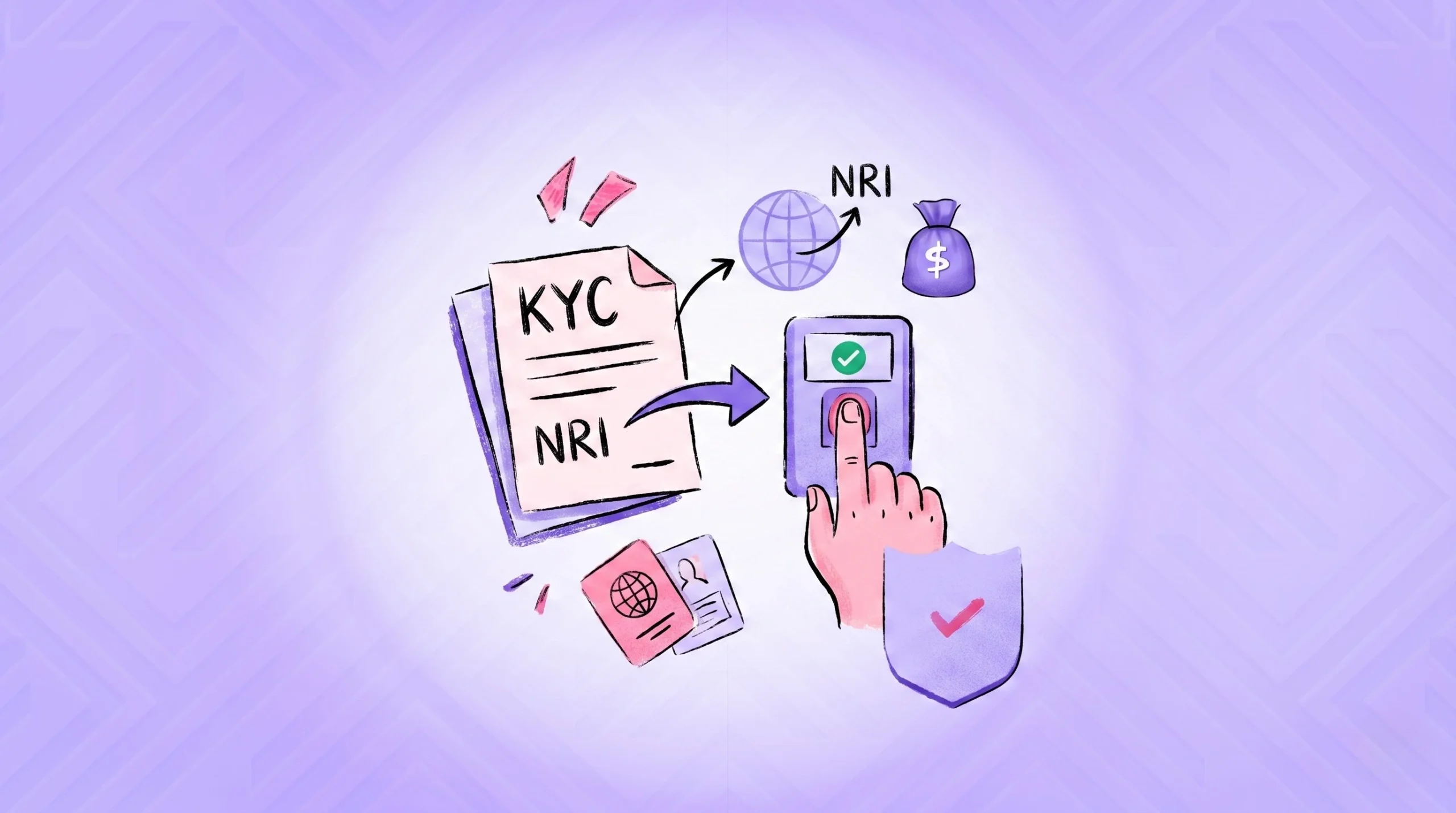
NRI KYC is not just resident KYC with a passport attached. It sits under a different regulatory stack (FEMA plus RBI plus PMLA plus, for investments, SEBI), uses a different documentation standard, and gets rejected for a distinct set of reasons that resident KYC almost never sees. Most of those rejections come down to one problem: attestation. This guide walks through NRI KYC end-to-end: who qualifies as an NRI for KYC purposes, which documents are needed, how attestation actually works, what changes by account type, and how NRIs running into FATCA restrictions can still invest. For the document-side workflow, our online passport verification explainer covers what happens under the hood.
Who Qualifies as an NRI for KYC Purposes
NRI status is not a single definition, and the confusion around it is the first reason KYC applications get rejected. Two different laws define residency in ways that can disagree for the same person in the same year.
FEMA Residency vs Income Tax Residency
FEMA (Foreign Exchange Management Act, 1999) defines a person’s residency based on intent and physical presence, primarily whether the person has gone out of India for employment, business, or an indefinite stay abroad. The Income Tax Act, 1961 defines residency based on day-count thresholds in a financial year. These two definitions often disagree. A person who just moved abroad might still be a tax-resident under IT law but is already a non-resident under FEMA. Banks and financial institutions run KYC under FEMA. Tax positions follow IT law. This distinction matters because getting it wrong causes account-type confusion (NRE vs NRO) and, in a few cases, FATCA classification errors.
NRI, PIO, and OCI: Three Different Statuses
NRI is the residency status (under FEMA). PIO (Person of Indian Origin) and OCI (Overseas Citizen of India) are categories for people of Indian origin who hold foreign citizenship. The PIO card was merged into OCI in 2015, so most current applicants will be OCI holders. Each status has different documentation. NRIs provide passport plus Indian nationality proof. OCIs provide the OCI card plus foreign passport. The KYC documents required at a bank or AMC vary slightly by status, which the forms usually flag but the attestation standards do not.
Restricted Jurisdictions That Complicate NRI KYC
A small group of jurisdictions triggers additional KYC scrutiny. Customers resident in FATF grey-list or black-list countries face Enhanced Due Diligence. US and Canada-based NRIs hit a different problem: the Foreign Account Tax Compliance Act (FATCA) imposes reporting obligations on Indian financial institutions that have US-person customers, and several Indian AMCs respond by not accepting US or Canadian NRIs at all. This is not a KYC rule per se; it is a commercial response to the reporting burden, but it shapes the NRI’s account-opening options.
Regulatory Framework for NRI KYC
The framework has three layers, and understanding which layer governs which part of the process keeps compliance conversations unambiguous.
FEMA and RBI Master Directions
FEMA governs all foreign-exchange-adjacent transactions in India, including opening NRE, NRO, and FCNR accounts, and buying Indian financial products as an NRI. The RBI implements FEMA through Master Directions, including the NRI-specific RBI notifications that cover transfer of assets, remittance limits, and account operation. The RBI KYC Master Direction applies to NRI customers of banks, NBFCs, and other regulated entities, with non-face-to-face allowances that matter for NRIs who cannot walk into an Indian branch.
PMLA and Reporting-Entity Obligations
PMLA obligations apply equally to NRI customers. The Prevention of Money-Laundering (Maintenance of Records) Rules, 2005 require record retention, STR/CTR reporting, and beneficial ownership capture for NRIs just as for residents. What changes is the practical process of collecting documents that satisfy these requirements from a customer who is not physically in India.
SEBI for Investment Accounts
SEBI governs investment-side NRI KYC through its KRA framework. NRIs investing in mutual funds, demat accounts, or portfolio management services complete their KYC through one of the five SEBI-registered KRAs, with the record becoming portable across SEBI-regulated intermediaries once processed. The April 2024 three-tier KYC status model (Validated, Registered, On Hold) applies to NRIs too.
Documents Required for NRI KYC
The document list is standard; the quality bar and attestation requirements are where NRI KYC diverges.
Proof of Identity
Passport is mandatory. PAN is mandatory for anyone investing in Indian financial products. Additional accepted IDs include the OCI or PIO card (for persons of Indian origin with foreign citizenship), an Indian driving licence (rare but accepted), and Aadhaar (only if the NRI holds one issued while they were resident).
Proof of Overseas Address
A utility bill, bank statement, driving licence, or government-issued ID issued overseas serves as proof of address. The key constraints: the document must be recent (typically within three months for utility bills), issued by a recognised authority in the country of residence, and in a language that the regulated entity can verify (translation and attestation required for non-English documents).
Proof of Indian Address (If Applicable)
Not mandatory for NRI KYC but useful for NRIs who maintain an Indian address for correspondence, including a family address, a rented property in India, or an ancestral property. Aadhaar is commonly used here if the NRI holds one. Utility bills, rental agreements, and property documents are also accepted.
Attestation: Where NRI KYC Actually Breaks
This is the single most common cause of NRI KYC rejection. Documents collected abroad must be attested by one of three authorised parties: an Indian embassy or consulate in the NRI’s country of residence, a notary public in the country of residence (a specific notary format is required), or an authorised branch manager of an overseas branch of an Indian bank (State Bank of India, ICICI, HDFC, and others maintain overseas branches for this purpose). Self-attestation is not sufficient. Many NRI KYC applications arrive with self-attested documents and are rejected back without any other review happening. Getting attestation right up front saves weeks of back-and-forth.
NRI KYC for Banking and Investments
The document stack is similar across banking and investment KYC, but the account types and special obligations differ.
NRE, NRO, and FCNR Account KYC
NRE (Non-Resident External) accounts hold foreign-sourced income, are freely repatriable, and are the default for NRIs’ overseas earnings. NRO (Non-Resident Ordinary) accounts hold Indian-sourced income (rent, dividends, pension) and have repatriation limits. FCNR(B) accounts are fixed deposits in foreign currency with defined tenors. KYC documentation is largely the same across all three; the difference is the source-of-funds declaration, which must match the account type. NRE mandates foreign-sourced funds only, and the KYC file captures this declaration.
NRI KYC for Mutual Funds and Demat Accounts
Mutual fund KYC for NRIs goes through the KRA framework just as for residents, with additional FATCA declarations. Demat and trading accounts add the Portfolio Investment Scheme (PIS) requirement, which is an RBI-mandated route for NRIs to buy Indian stocks. Our guide on activating KYC in investment apps covers the resident-side flow; NRI versions follow the same basic structure with the additional FATCA and attestation overlay.
FATCA Implications for US and Canadian NRIs
The Foreign Account Tax Compliance Act is US law that requires non-US financial institutions to report accounts held by US persons to the IRS. Canada has a similar regime. Indian AMCs and banks comply by either asking US and Canadian NRIs for additional declarations (W-9 or equivalent) and then accepting them, or by declining the relationship entirely to avoid the reporting burden. Most major AMCs accept US and Canadian NRIs with the FATCA overlay; a small number do not. Before starting the KYC process, US and Canadian NRIs should confirm the AMC or broker’s FATCA stance.
Completing NRI KYC Online
Non-face-to-face KYC is where the NRI experience has improved significantly in the last few years. Two paths dominate.
Video KYC (V-CIP) for NRIs
RBI’s V-CIP allowance for non-face-to-face onboarding covers NRIs. The session must be real-time, the officer must be a trained employee of the regulated entity, and the time-zone coordination can be tricky but is solvable. Regulated entities running high NRI volumes typically stand up dedicated V-CIP schedules for overseas time zones, backed by a video KYC API that handles session orchestration.
DigiLocker for NRIs
DigiLocker works for NRIs who have a DigiLocker account linked to an Indian mobile number. The catch is that many NRIs either do not have one or lost access to the linked Indian SIM. For those who do, fetching Aadhaar and PAN through DigiLocker produces cleanly digitally-signed documents that bypass the attestation problem described earlier. The regulated entity still validates the NRI’s overseas address separately, but the India-side KYC is substantially simpler.
Common NRI KYC Issues and How to Fix Them
Three rejection patterns account for the majority of NRI KYC failures.
KYC Rejected Due to Attestation
The most common rejection. Self-attested documents, documents notarised in a format that does not match Indian requirements, or documents attested by a non-authorised party all fail. The fix: either get the documents attested correctly from the start (Indian embassy, recognised notary, or overseas branch of an Indian bank), or use DigiLocker where applicable to avoid the attestation path entirely.
PAN and Name Mismatches
Middle-name conventions vary across jurisdictions. A passport issued by a country that splits given names and surnames differently from India can create mismatches against the PAN record. The fix is to apply for a PAN update that reconciles the name exactly with the passport, or to submit a name-affidavit acceptable to the Indian financial institution. This is easier to fix before KYC submission than during.
FATCA Declaration Errors
US-person classification under FATCA is specific: it captures US citizens, green card holders, and tax residents. NRIs who are not US persons but who had US connections (past work, family in the US) sometimes check the wrong box on the FATCA declaration and cause subsequent account rejections. The fix is to read the US-person definition carefully, and for borderline cases, seek professional tax advice before submitting. Periodic re-KYC often revisits FATCA status, which is another opportunity to catch and correct.
How Should Financial Institutions Handle NRI KYC
For banks, NBFCs, AMCs, and fintechs serving NRIs at scale, the rejection and friction patterns described above translate into specific operational design choices. Four measures separate efficient NRI KYC programmes from the average.
Pre-Validate Attestation at the Point of Capture
The single biggest efficiency unlock is catching attestation problems at capture rather than during review. At the moment a document is uploaded, the system should check for the signals that mark valid attestation: the stamp or letterhead of the attesting authority, the notary registration number, an embassy seal in the expected format, or the branch code of an overseas Indian bank. Where possible, apply OCR and layout validation to the attestation stamp itself, not just to the underlying document. Customers get rejection feedback in minutes, not weeks of back-and-forth, and first-time-right rates climb substantially.
Orchestrate V-CIP Across Overseas Time Zones
A V-CIP scheduling system designed for India-resident customers does not serve NRIs well. NRIs live across time zones that span the full 24-hour clock, and a single-shift V-CIP operation forces them to take sessions at unreasonable hours. Institutions running NRI volumes should offer dedicated V-CIP slots for the time zones where most of their NRI book lives (typically the US, UK, UAE, Singapore, and Australia), staff a second or third shift, and detect the customer’s time zone at the appointment-booking step to surface only relevant windows. The conversion uplift at the NRI segment tends to justify the operational cost.
Build a Separate Manual Review Queue for NRI Cases
NRI KYC cases require reviewers with domain knowledge that resident-KYC reviewers do not typically have: FEMA residency rules, FATCA classification, valid attestation formats across multiple countries, and account-type interactions (NRE vs NRO vs FCNR). Pooling NRI cases into the same manual review queue as resident cases causes delays because generalist reviewers bounce NRI files to specialists, and rework because generalist reviewers sometimes approve borderline files that a specialist would have escalated. A separate NRI queue with trained reviewers gives faster SLAs and a higher first-time-right rate.
Make FATCA Declaration a First-Class Step
FATCA declarations often get bolted onto NRI KYC as an afterthought, captured informally and stored alongside the rest of the document stack. This is the pattern that causes the most downstream account-opening rejections, because the product or AMC policy engine discovers the FATCA status only at the point of account creation. Capturing FATCA status as a first-class step (with its own audit trail, its own validation, and integration with the product’s FATCA policy engine) surfaces the issue at onboarding rather than at disbursal. For institutions whose AMC partners have different FATCA stances, the policy engine routes the customer to an accepting AMC automatically.
Getting Your NRI KYC Done
For the individual NRI, the practical order is: confirm FEMA residency and FATCA status, gather the document stack (passport, PAN, overseas address proof, Indian address if any), get attestation done through an Indian embassy, recognised notary, or overseas Indian bank branch, and then submit through the bank or AMC of choice.
To see how HyperVerge handles NRI KYC with passport OCR, global address proof verification, V-CIP across time zones, and FATCA declaration capture in one flow, sign up for a walkthrough.