





Most Indians have a CKYC record and do not know it. Anyone who has opened a bank account, bought a mutual fund, or taken a loan in the last several years is almost certainly registered in the Central KYC Records Registry. That single record is meant to make every subsequent KYC across banks, mutual funds, insurers, and NBFCs faster and lighter. This guide explains what CKYC is, how the 14-digit identifier works, how CKYC differs from KRA KYC and eKYC, and what the move to CKYCRR 2.0 means for both consumers and regulated entities in 2026.
What Is CKYC?
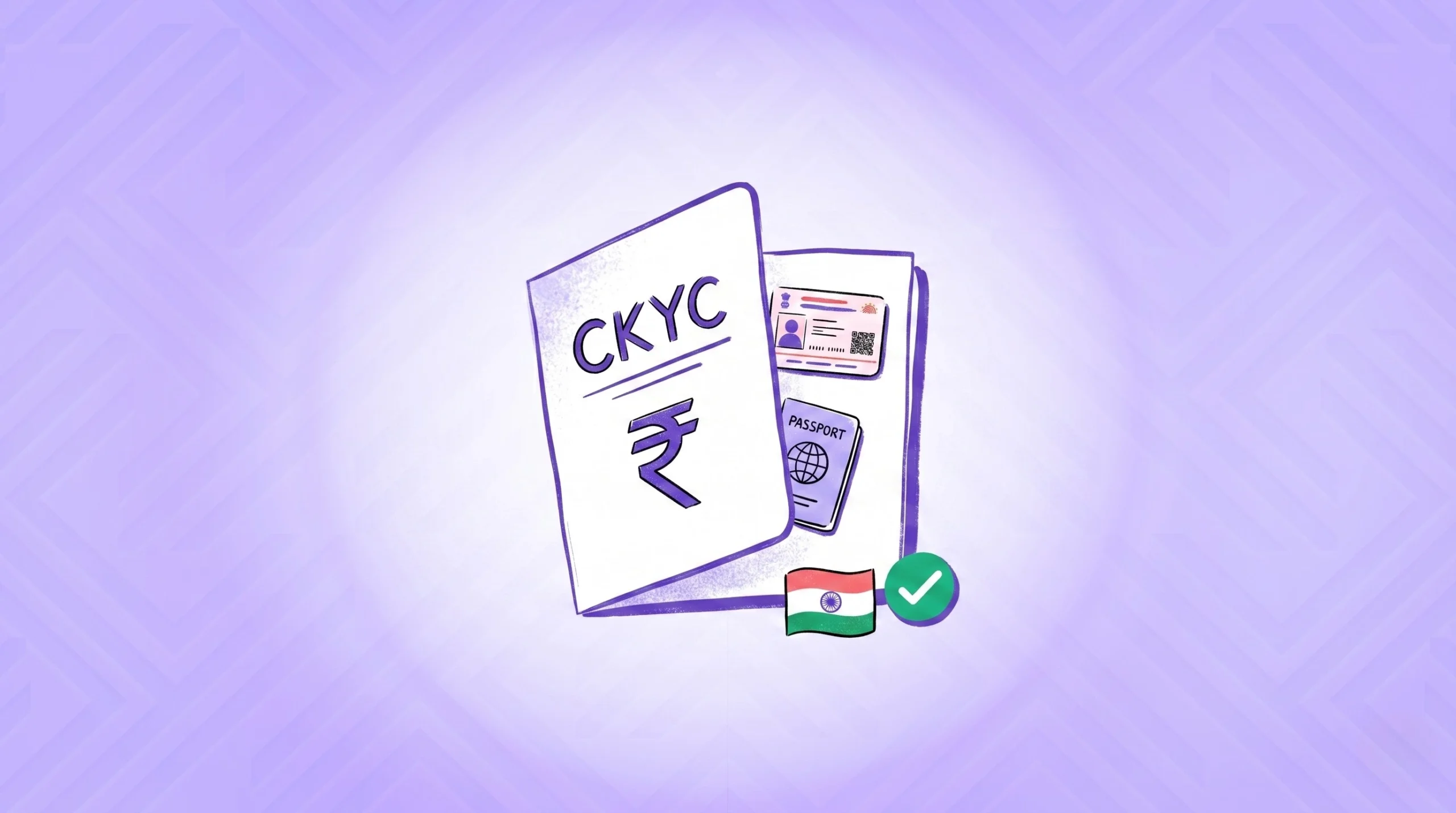
Central KYC, or CKYC, is India’s pan-regulator registry for customer KYC records. It is operated by the Central Registry of Securitisation Asset Reconstruction and Security Interest of India, better known as CERSAI. The idea is simple. A customer completes KYC once with any regulated entity, the record is uploaded to CKYC, and a unique 14-digit identifier is assigned. Every other regulated entity, across RBI, SEBI, IRDAI, and PFRDA jurisdictions, can then retrieve that record instead of asking the customer to submit documents again.
CKYC Defined
CKYC is a repository, not a verification service. It stores the KYC data that a regulated entity has already verified, in a standardised format, against a unique customer identifier. The distinction matters. CKYC does not replace KYC, it stores the output of it, making reuse possible across institutions. A mature CKYC implementation reduces duplicate submissions for the customer and reduces duplicate compliance work for the institution.
The 14-Digit CKYC Identifier Number (KIN)
The CKYC Identifier Number, commonly called the KIN, is a 14-digit number assigned when a customer’s KYC record is first registered with CKYCR. Each segment encodes information about the record, including the customer type (individual, legal entity, or minor), which is why different CKYC formats exist for different customer categories. After registration, CERSAI sends the KIN to the customer’s registered mobile and email. Regulated entities display the KIN on passbooks, account statements, demat accounts, and insurance policies, so most customers can find theirs on a recent statement.
Who Operates CKYC
CERSAI operates the CKYC Records Registry on behalf of the Government of India, authorised under the Prevention of Money Laundering Act, 2002 and the Rules made thereunder. The Department of Revenue within the Ministry of Finance provides policy oversight, with sectoral regulators (RBI, SEBI, IRDAI, PFRDA) enforcing CKYC obligations for the entities they supervise. That cross-regulator coverage is what makes CKYC different from registry systems that only serve one sector.
How CKYC Works
It helps to think of CKYC as three connected flows: first-time upload, later lookup, and ongoing updates.

First-Time Upload at Onboarding
When a customer completes KYC with a regulated entity for the first time, that institution uploads the record to CKYCR. The upload includes standard identity fields (name, date of birth, address, identity proof type and number) along with any supporting document images. CERSAI validates the submission, allocates a 14-digit KIN, and returns it to the regulated entity. Institutions display the KIN on passbooks, account statements, demat holdings, and insurance policies as a matter of regulatory requirement.
Lookup by a Second Regulated Entity
When the customer later approaches a different regulated entity, say a mutual fund distributor after the bank, that institution queries CKYCR using the customer’s PAN, Aadhaar, or KIN. The registry returns a standardised KYC packet. The second institution can rely on the CKYC record for onboarding, subject to its own risk-based conditions, rather than repeat the full KYC exercise. Under current RBI guidance, an institution relying on a CKYC record still owns the risk rating decision, which is a nuance compliance teams often miss.
Updates and Amendments
CKYC is only useful if the data stays current. When a customer’s address, contact details, or identity documents change, the institution holding the primary relationship is responsible for pushing the update to CKYCR. As of a June 2025 regulatory circular, regulated entities must first download the current CKYC record, compare it with the new data, and raise a modification request only where there is an actual change. Blind overwrites are no longer acceptable. This is part of a broader tightening around data quality in the registry.
CKYC vs KRA KYC vs eKYC: Clearing the Confusion
These three terms get used interchangeably, and they should not be. They refer to different things, and confusing them leads to real compliance errors.
| Feature | CKYC | KRA KYC | eKYC |
|---|---|---|---|
| What it is | Pan-regulator KYC repository | SEBI intermediary KYC registry | Method of verifying identity |
| Operator | CERSAI | Five SEBI-registered KRAs (CAMS, CVL, Kfin, NDML, DotEx) | UIDAI (for Aadhaar eKYC) |
| Scope | RBI, SEBI, IRDAI, PFRDA entities | SEBI intermediaries only | Method, not registry |
| Identifier | 14-digit KIN | PAN-based record | Not applicable |
| Legal basis | PMLA, 2002 | SEBI KRA Regulations, 2011 | Aadhaar Act, 2016 |
CKYC Scope: All Financial Regulators
CKYC’s distinguishing feature is its regulator-agnostic scope. A CKYC record is usable across banks, NBFCs, mutual funds, insurance companies, and pension fund intermediaries. No other Indian KYC infrastructure matches that breadth.
KRA KYC Scope: SEBI Intermediaries Only
KRAs, the KYC Registration Agencies, were set up under SEBI’s 2011 regulations and serve only SEBI-regulated intermediaries: mutual fund distributors, stockbrokers, portfolio managers, and similar. There are five SEBI-registered KRAs today. KRAs upload to CKYCR too, which is why investors often see references to both CAMS KRA and CKYC simultaneously. HyperVerge’s KRA KYC API is one example of how this integration gets exposed to product teams building on top of the KRA layer.
eKYC Is a Method, Not a Registry
eKYC is the most misused of the three terms. It refers to a method of verifying identity, typically using Aadhaar OTP, biometric authentication, or offline Aadhaar XML. eKYC can be the verification step whose output is then pushed to CKYCR. The two are complementary, not substitutes.
With the taxonomy clear, the next question for most readers is practical: where is my CKYC number?
How to Find or Check Your CKYC Number
Most customers already have a KIN and do not realise it. Three paths usually find it.
On Your Financial Institution Records
Banks, mutual fund houses, brokers, and insurers are required to display the CKYC identifier on customer-facing documents. Check your passbook, a recent bank statement, your mutual fund folio statement, your demat holdings statement, or a recent insurance policy document. The 14-digit KIN is typically printed in the customer profile section.
Through a Regulated Entity
If your KIN is not visible on any statement, the quickest path is to ask any regulated entity where you have an account to pull it from CKYCR on your behalf. Most bank branches and digital banking platforms can do this through their existing CKYC integration. Regulated entities are permitted to download the full record with customer consent.
Creating a Fresh CKYC If None Exists
A very small number of customers, typically those who have never held a financial account in India, will have no CKYC record at all. In that case, the solution is straightforward: complete KYC at any regulated entity, either online through a video KYC session or in person, and a new KIN will be assigned as part of that onboarding.
CKYC Registration: The First-Time Process
For first-time registrations, the flow is standard across institutions.
Documents Required
PAN is mandatory for individual CKYC registration. The second document is a proof of address, typically Aadhaar, passport, driving licence, or voter ID. A recent photograph is also required. For customers registering via DigiLocker, the documents are fetched directly from the issuer in a verified format, which removes most document-tampering risk.
Where to Initiate Registration
CKYC registration happens at the first regulated entity the customer onboards with. That could be a bank, an NBFC, a mutual fund distributor, or an insurance intermediary. The customer does not interact with CERSAI directly. The institution is responsible for uploading to CKYCR and returning the KIN to the customer.
Typical Timelines
The regulated entity typically completes CKYC upload within 10 working days of KYC completion, per the current CKYCR upload guidance. The KIN is then available on downstream statements and for use by other institutions.
CKYC for Different Customer Types
CKYC is not one-size-fits-all. The registry supports different record templates for different customer categories.
Individuals: Three Tiers
Individual CKYC records come in three tiers: KYC Normal, KYC Simplified, and KYC Small. KYC Normal is the standard full record, applicable to most accounts. KYC Simplified is a lighter version for low-value accounts and Basic Savings Bank Deposit accounts. KYC Small is for the smallest-balance accounts where only minimal identification is required. Each tier unlocks different transaction limits and product access, which is why the tier matters operationally and is not just a classification detail.
Legal Entities
Since April 1, 2021, CKYCR has supported legal entity records, including companies, LLPs, partnerships, and trusts. The record structure differs from individuals, capturing beneficial ownership, authorised signatories, and entity-specific identifiers. This extension closed a long-standing gap where corporate KYC reuse had no pan-regulator mechanism.
Non-Resident Indians
NRIs also have CKYC records, though the documentation differs from resident individuals. Passport is the primary identity document, along with overseas address proof, and attestation by an Indian embassy, consulate, or notary where required. FATCA declarations are collected alongside. NRIs working with multiple Indian financial institutions benefit disproportionately from CKYC because document attestation is the most tedious part of their onboarding, and reuse via CKYC avoids repeating it.
CKYC for Regulated Entities: The Compliance Obligation
For product and compliance teams, CKYC comes with specific obligations that have tightened since 2024.
Mandatory Upload and Query Before Onboard
Regulated entities must upload new KYC records to CKYCR within 10 working days of KYC completion. Before running fresh KYC on a customer, they are expected to query CKYCR first and use the existing record where available. This reduces duplicate submissions and is consistent with the 2nd Amendment to the RBI KYC Master Direction and broader ongoing due diligence expectations articulated in the FATF Recommendations.
Reliance, Not Transfer of Accountability
A regulated entity that relies on a CKYC record is not absolved of its own KYC obligations. Recent RBI guidance has been explicit on this point: reliance is permitted only where the CKYC record is current and fully PMLA-compliant, and the relying entity must still apply its own risk-based customer due diligence. Factual errors in CKYC data are attributable primarily to the institution that last updated the record, but risk assessment and reporting remain the relying entity’s responsibility.
What’s Changing: CKYCRR 2.0
The biggest development in Indian KYC infrastructure in 2025 and 2026 is the move to CKYCRR 2.0, announced by the Finance Minister in the Union Budget 2025 speech.
Real-Time API-First Architecture
CKYCRR 2.0 replaces static PDF records with real-time JSON and XML API submissions. This changes the operational tempo from batch uploads to ongoing synchronisation, which aligns closely with the trend toward periodic and perpetual KYC in the broader regulatory framework.
New Consumer Safeguards
The 2.0 rollout brings Aadhaar masking, OTP-based consent for every data access event, and a self-service consumer portal. These are meaningful privacy upgrades that move the registry from a compliance-only tool to something consumers can actively engage with.
Making the Most of Your CKYC
For customers, CKYC is most useful when you know your KIN and keep your contact details current at your primary financial institution. That single step keeps your record updated across every downstream institution you deal with. For product and compliance teams, CKYC is increasingly the single most efficient onboarding accelerant in the Indian market, especially as CKYCRR 2.0 brings real-time APIs and stronger data quality controls into force.
To see how CKYC integrates alongside video KYC, DigiLocker, and Aadhaar eKYC in one onboarding flow, sign up for a HyperVerge walkthrough.