







At Global Fintech Fest 2025, where over 50,000 leaders from 90+ countries gathered, one question echoed across every booth, panel, and boardroom huddle.
Is India preparing to lead the global fintech revolution, or has it already taken the lead?
As a first-time attendee, I was impressed by the numbers alone, but what was even more impressive was the absolute spirit of cooperation and collaboration.
When Prime Minister Narendra Modi took the stage, the excitement around the Jio World Centre was electric. His address wasn’t a vision for the future, it was a declaration of arrival.
The numbers that followed told their own story: UPI processing over 16 billion transactions a month, AI reshaping lending and fraud prevention, and Indian fintechs eyeing global markets. All of this made one thing clear:
GFF 2025 wasn’t just an industry event. It was India’s global fintech platform, and AI is undeniably the launchpad for that.
Even though AI dominated every conversation as expected, some very specific nuances came out of this 3-day insight-packed fest. Here are some of the most powerful insights that came out of GFF 2025.
1. Agentic AI is in Production, Not a Slide
Walk into any major fintech’s customer support floor today, and you’ll witness something remarkable: AI agents speaking Tamil, Bengali, and Hinglish with near-human fluency. Not in pilot, not in testing, but in production.
GFF 2025 made one thing clear: the firms still treating agentic AI as a “future experiment” are already behind.
Unlike traditional chatbots that follow rigid scripts, agentic AI systems analyze context, make decisions, take actions, and learn from outcomes in real time. They’re not assisting humans, they’re acting within workflows.
At the event, examples spoke louder than slides:
- Vernacular voice agents now manage complete loan, onboarding, and collections conversations. Outperforming human agents in some cases while handling ten times the volume.
- In-app copilots can predict drop-offs before they happen
- Contact centers use AI to autonomously resolve Tier-1 queries, escalate with full context, and follow up post-resolution.
Agentic AI isn’t a concept anymore, it’s running BFSI operations at scale.
The question isn’t “if” you’ll adopt it, but “how fast” you can.
2. Small Models, Big Impact: How BFSI Is Moving Beyond LLM Hype
Across sessions, one theme echoed from engineering heads to CTO panels: banks don’t need 70-billion-parameter models to answer underwriting questions or analyze KYC documents. What they need are small, fine-tuned, explainable models that can run efficiently within their own infrastructure.
One bank, for instance, revealed it’s already running over 20 in-house LLMs, each optimized for a specific task, such as credit memo summarization, policy compliance checks, or CX sentiment analysis. Others are training “Small Language Models” (SLMs) on a blend of internal and public financial data to reduce inference costs and response latency by as much as 60–70%.
The trade-off is clear: slightly less general intelligence in exchange for faster, cheaper, more compliant performance.
And that shift isn’t just about efficiency, it’s about control.
With in-house models, data never leaves the firewall. Finetuning cycles are faster. Model behavior is auditable, and the IP remains owned by the enterprise, not an API vendor.
3. BFSI Leaders Are Reinventing Cybersecurity and Fraud Prevention
Banks, NBFCs, and payment players are realizing that every identity breach, fraudulent transaction, or compliance lapse ultimately damages the same thing: trust. And that’s forcing a structural rethink of how these systems connect.
Across GFF, conversations shifted from isolated risk controls to continuous verification ecosystems:
- Lenders spoke about unifying KYC, CKYC, and AML layers into a single decision engine that checks authenticity, risk, and regulatory compliance in one pass.
- Insurers and brokers showcased face-liveness + deepfake detection models being embedded directly into onboarding and claims.
Some concerns also emerged during the panel discussion our CEO, Mr. Kedar Kulkarni, moderated, “AI-driven Risk Management and Fraud.”
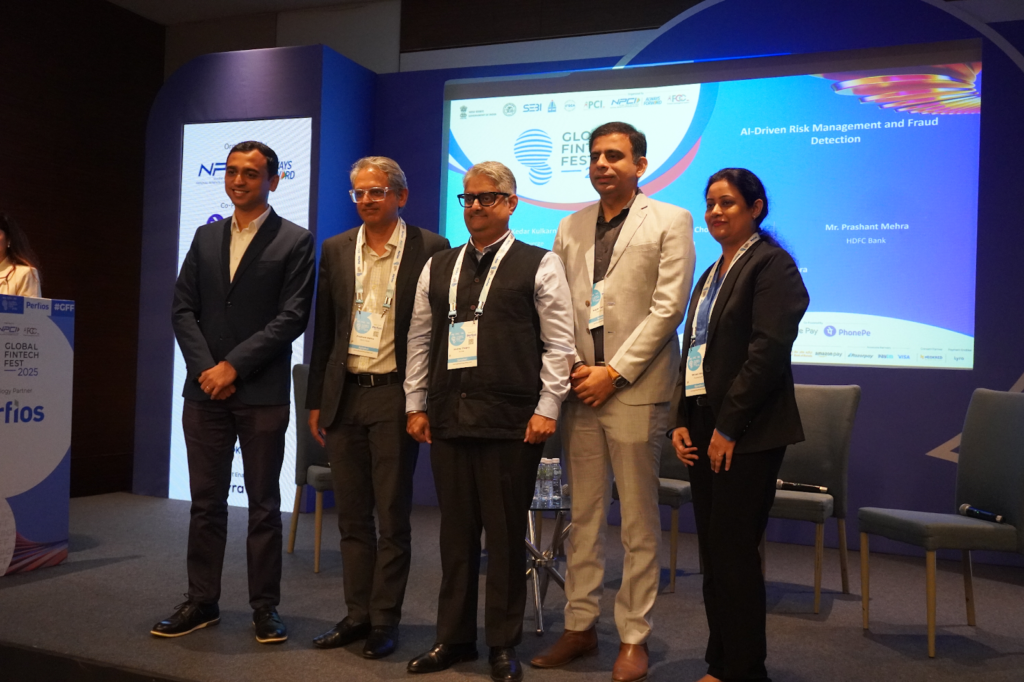
The panelists shared anecdotes regarding the shortcomings of AI-based security and how we can still effectively leverage AI to elevate human intervention, rather than replace it.
The new digital-trust architecture emerging from GFF 2025 has three defining traits:
- Unified Identity Intelligence: every user, device, and transaction mapped to a dynamic risk score.
- Explainable AI: every decision traceable, auditable, and regulator-ready.
- Real-Time Resilience: continuous monitoring instead of one-time KYC, with alerts for anomalies as they happen.
In a world where fraud moves faster than policy, digital trust is becoming the ultimate competitive moat.
4. Follow the Graph: AML & Mule Detection Matures
The NPCI session on money mule detection drew a full house. It demonstrated how graph AI and behavioral features can uncover hidden account networks long before fraud is reported.
Traditional fraud systems look for suspicious transactions. Graph AI looks for suspicious connections. By mapping relationships between accounts, devices, IPs, and merchants, financial institutions are finally seeing what linear rules could never reveal, entire fraud rings hiding in plain sight.
The numbers were staggering: NPCI’s system now processes up to 120 billion transactions, analyzing 350+ behavioral and transactional features to spot cyclic flows, sudden fund movements, and dormant-account spikes. The approach combines graph topology with adversarial synthetic data built in collaboration with IITs, ensuring that detection models stay resilient against evolving fraud tactics.
The results showed precision rates over 60%, even across massive transaction volumes.
The emerging pattern is clear: BFSI leaders are beginning to treat fraud detection not as a compliance checkbox, but as a living network analysis problem.
5. Inclusion Beyond Tier-1: Bharat Is the New Digital Frontier
We were pleasantly surprised by the human touch that AI transformation demonstrated at GFF 2025. Some of the biggest winners at the GFF awards were solutions like Pay Nearby that focused on delivering technology to the last leg of Bharat that was beyond cities and big towns.
Across panels, leaders from regional NBFCs and fintechs shared how they’re rebuilding onboarding and service journeys for language, literacy, and local context.
Vernacular AI agents, assisted onboarding through kiosks and field apps, and lenders piloting appraisal models using smartphone cameras are all examples of the innovations that are fueling accessibility and inclusion.
The new definition of inclusion goes beyond access. It’s about trust, language, and dignity in digital finance. Those who build for Bharat’s reality will define the next decade of financial growth.
Future Outlook: What’s Next for Indian Fintech?
GFF 2025 proved that India is not just a participant in the Global Fintech race, it is a serious competitor. With several native AI models already showing promise, India no longer needs to rely on the West solely for technology.
In the coming years, businesses that assimilate with the right technology will see the highest benefits.
Between 2025 and 2030, the Indian fintech market is projected to double in size, crossing $250 billion in value, powered by near-universal smartphone penetration, expanding credit rails, and a regulatory push toward digital accountability. Expect to see:
- AI-first operations across underwriting, fraud, and CX becoming standard practice by 2027.
- Small Language Models (SLMs) replacing generic APIs for secure, in-house intelligence.
- Agentic systems embedded across every customer journey: from lending to collections to claims.
On the regulatory front, India’s institutions are preparing for continuous compliance, real-time visibility into risk, consent, and data lineage.
All of this aligns with the vision of Viksit Bharat 2047: a financially inclusive, digitally sovereign economy. By then, the goal isn’t just 100% financial access. It’s 100% intelligent access: services that speak the user’s language, verify identity instantly, and build trust automatically.
If 2025 was the year Indian BFSI turned AI-ready, the next five years will decide who becomes AI-native.