
Quick takeaways
- HyperVerge focuses on single-image passive liveness requiring zero user action, while Amazon Rekognition uses active, challenge-based liveness detection via a video selfie.
- Both detect digital and physical spoofs in the form of printed photos, screen replays, 3D masks, and deepfake injection attacks.
- HyperVerge supports on-device processing through its SDK-based architecture, while Amazon Rekognition is API-driven, with all processing handled on AWS cloud servers.
- HyperVerge is ideal for regulated businesses orchestrating end-to-end KYC and KYB checks; Amazon Rekognition is ideal for businesses already operating within an established AWS infrastructure.
What is Amazon Rekognition Face Liveness?
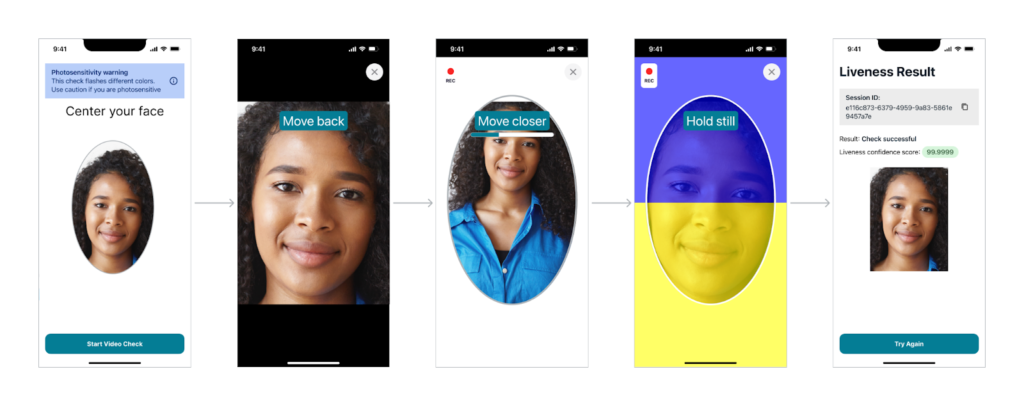
Amazon Rekognition Face Liveness is a fully managed ML feature by AWS that verifies a user’s physical presence at the time of authentication.
Face Liveness is designed to detect physical spoof attacks presented to the camera—printed photos, digital photos, digital videos, 3D masks—as well as sophisticated digital injection attacks like pre-recorded or deepfake videos injected directly into the video capture subsystem.
Upon completing the check, Amazon Rekognition returns:
- A probabilistic liveness confidence score between 0 and 100
- A high-quality reference image extracted from the session video
- A session status: Successful or Unsuccessful
How do the front-end and back-end work?
Rekognition Face Liveness operates through three cloud APIs and requires AWS Amplify SDK for client-side capture. The full lifecycle, from session creation to result retrieval, runs within AWS-managed infrastructure.
Amazon Rekognition key features

Via source
- Active liveness challenge: During a liveness check, users are required to move their face into an on-screen oval and hold still while the device displays a sequence of colored lights
- Biometric integrity: ML models trained on diverse datasets to provide high accuracy across user skin tones, ancestries, and devices
- Developer-centric integration: No ML expertise, hardware-specific implementation, or infrastructure management is required from the developer. The underlying AI models are pre-trained and fully managed by the provider.
- Customizable challenge modes: Organizations can choose between FaceMovementAndLightChallenge for maximum accuracy or FaceMovementChallenge that prioritizes speed
- Adjustable accuracy: Liveness accuracy can be optimized by the developer through adjustable confidence thresholds based on the specific environmental conditions of their use case
- Per-check pricing: Organizations only pay for the liveness checks they perform
- Regional availability: Available in five AWS regions—US East (N. Virginia), US West (Oregon), Europe (Ireland), Asia Pacific (Tokyo), and Asia Pacific (Mumbai)
Amazon Rekognition Face Liveness pros

- Comprehensive spoof detection across both presentation and digital injection attacks
- No ML expertise or infrastructure management required
- Passes iBeta Level 1 and Level 2 PAD conformance testing
- Flexible confidence thresholds adaptable to different risk levels
- Composable with other Rekognition APIs
- Scalable without capacity planning
Amazon Rekognition Face Liveness cons
- Functionality relies on a combination of frontend client-side tools and backend cloud infrastructure provided exclusively by Amazon Web Services.
- Active challenge adds friction to the user verification flow
- Available in only five regions, limiting latency optimization globally
- No built-in compliance alignment for non-US regulatory frameworks like RBI V-CIP
- User experience elements cannot be customized
What is HyperVerge Face Liveness?
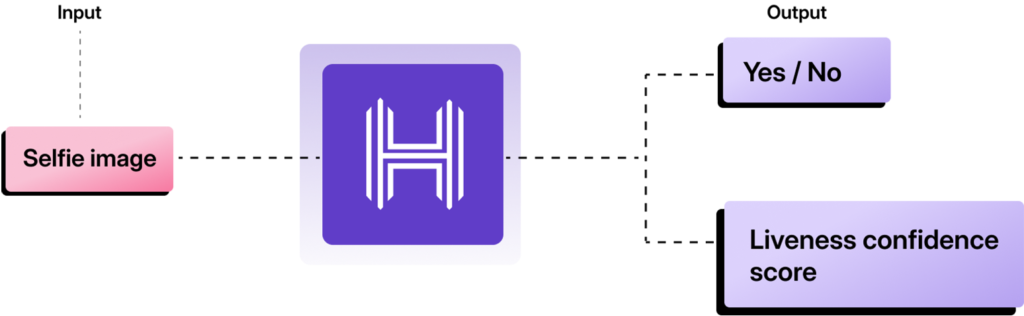
HyperVerge provides comprehensive identity verification and fraud prevention solutions for regulated industries across 195+ countries. Its face liveness detection is part of its no-code, end-to-end identity verification platform, HyperVerge ONE, which lets businesses configure and launch onboarding workflows without engineering dependencies.
HyperVerge positions itself as a leader in biometric security with its single-image passive liveness detection. It uses the same image captured for face recognition to detect subtle biometric cues like:
- Textural inconsistencies
- Screen reflections
- GAN artifacts
- Contour depth anomalies
- Device-signal mismatches.
Its proprietary AI models are trained on over 850 million liveness checks and diverse spoof datasets—including high-resolution screen replays, 2D/3D masks, and GAN-generated faces.
How does this translate to real-world deployment?
HyperVerge primarily offers SDK-based solutions for on-device processing alongside plug-and-play APIs for specific integration needs.
For organizations that need more than a liveness check—regulated BFSI institutions, high-volume digital lenders, or any business running complex onboarding flows—can opt for HyperVerge’s hybrid architecture, where the SDK handles real-time capture and local preprocessing, while APIs perform final server-side validation or broader analytics.
HyperVerge key features
- Spoof defense coverage: Defends against a broad spectrum of fraudulent attempts, including presentation attacks, digital and AI-generated attacks, face swaps, and Man-in-the-Middle (MITM) attacks
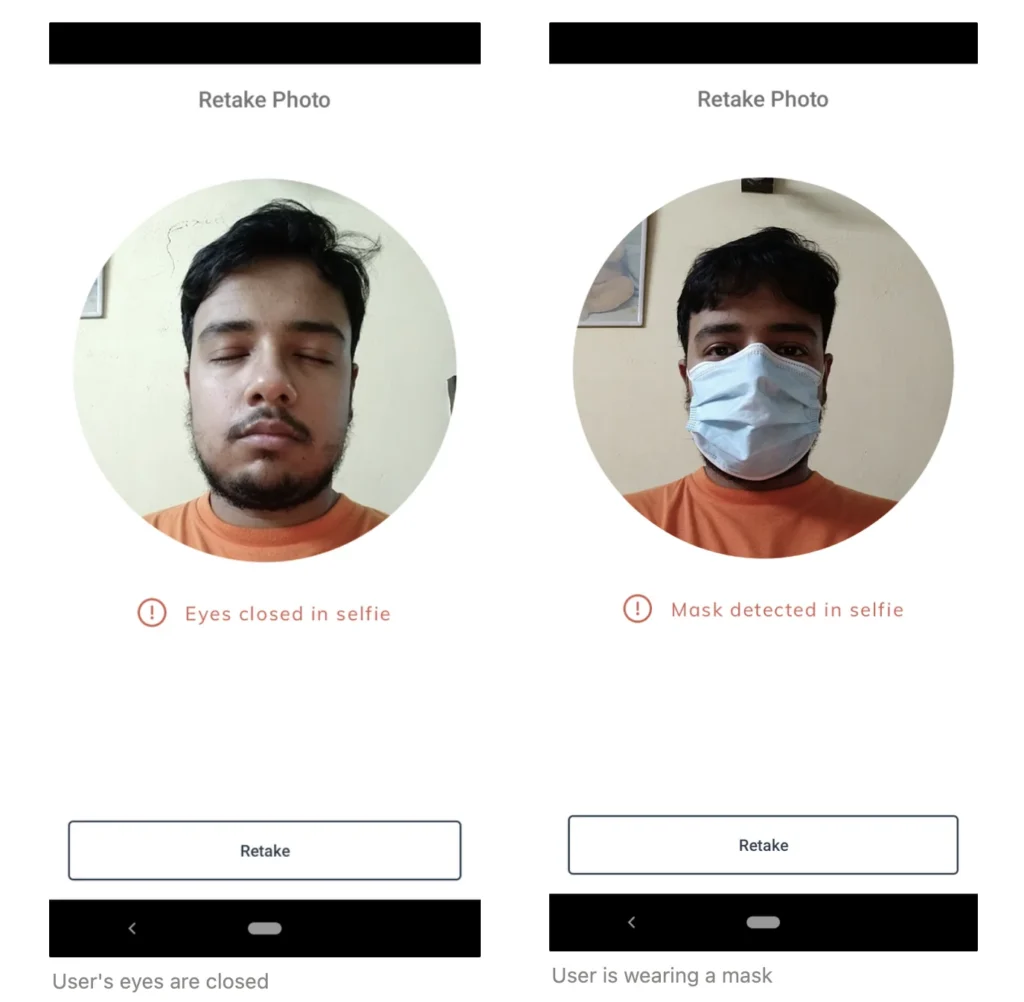
- Face quality checks: Detects blur, closed eyes, multiple faces, masked faces, and other non-compliant captures before the image enters the liveness pipeline
- Drop-off optimized UX: Real-time selfie quality feedback minimizes retries and keeps users moving through the onboarding flow
- India-specific fraud models: AI models trained specifically on Indian ID documents such as PAN cards, Aadhaar, Voter IDs, and passports to detect document forgery
- RBI V-CIP ready: Built for India’s Video KYC regulatory framework, with geo-tagging, consent capture, and audit trail requirements supported natively
- Layered fraud orchestration: Defends against increasingly sophisticated digital threats by combining passive liveness detection with device fingerprinting, behavioral biometrics, and risk-based authentication engines
- Offline-capable processing: On-device SDK handles real-time capture and local preprocessing without requiring an active internet connection
- Use-Case Optimization: HyperVerge allows setting different thresholds for varied, risk-based scenarios, such as high-value transactions versus low-risk onboarding
- SDK first architecture: On-device processing to prevent camera injection attacks directly at the source
HyperVerge Face Liveness pros

- Layered fraud orchestration beyond liveness checks, offering end-to-end onboarding coverage
- Compatible with 10,000+ devices
- Optimized for low-bandwidth regions like Tier 2 and Tier 3 markets in India—requires only 100–150 KB of data per evaluation without a continuous video stream.
- Signature verification to prevent MiTM attacks, plus anti-injection and anomaly detection to stop camera feed manipulation
- Average onboarding pass rate of 95%+
- Adheres to global frameworks (GDPR, HIPAA, FATF, NIST) and Indian regulatory guidelines for RBI V-CIP, SEBI, and IRDAI
- Launch custom onboarding journeys with fallback options without app releases.
HyperVerge Face Liveness cons
- Like most biometric systems, accuracy can be affected by poor lighting, face occlusions, or blurry captures—leading to false rejections of genuine users
- Architecture is designed for deep integration into full onboarding journeys—teams looking for a lightweight standalone liveness API will find it over-engineered for that purpose
Amazon Rekognition Face Liveness vs HyperVerge: Feature-by-Feature Comparison Table
| Feature | Amazon Rekognition | HyperVerge |
| Primary processing site | AWS Cloud (backend) | On-device (Local client-side) with a hybrid server-side option available |
| Input type | A short selfie video streamed in real-time to the cloud | A single selfie captured for face recognition |
| Latency | Average of 7 seconds (ranging from 5 to 11 seconds) | No added latency to the user journey as it uses the initial selfie |
| Scalability | Automatically scales to millions of liveness checks per day based on demand | Cloud-based deployment designed to enable large organizations to scale and onboard millions of users |
| Security mechanism | Stops injection at the source via the SDK | Detects injection via cloud-based ML models |
| Network dependancy | Required for the entire analysis, minimum 100 KBPS bandwidth | Can function with low bandwidth or offline once initiated |
| Detection logic | Reflective: Analyzes how light and movement change over time | Textural: Analyzes micro-details and synthetic patterns in one frame. |
| Real-World / Live Accuracy | Dependent on the customer-set threshold | ~99.8% Accurate Predictions |
| SDK dependancy | Amplify SDK is mandatory for front-end capture—cannot be substituted with a custom implementation | SDK-based for on-device processing; plug-and-play APIs available for server-side integration |
| Deployment | Fully managed services requiring no infrastructure | Integration is primarily through their proprietary SDK |
| Certification | iBeta ISO/IEC 30107-3 Level 1 & 2 compliant | ISO 30107-3 Level 2 compliant |
Accuracy & Fraud Detection Capabilities
Both Amazon Rekognition and HyperVerge offer high-accuracy liveness detection systems designed to deter sophisticated fraud, including presentation and digital injection attacks. While both are certified to the same international standards, they differ in their primary detection methods and real-world performance benchmarks.
Amazon Rekognition Face Liveness
Amazon’s solution uses a probabilistic calculation to determine liveness, primarily through a video-based challenge-response mechanism. Liveness determination depends on the confidence threshold configured by the customer and operational review policies.
Face Liveness in Amazon Rekognition is trained and tested using datasets that represent a diverse range of human facial features and skin tones under a wide range of environmental variations. This includes datasets of selfie videos with reliable demographic labels such as gender, age, and skin tone.
Known spoof vectors: Printed or digital photos, mask attacks, screen replay, deepfake
Amazon Rekognition Face Liveness Accuracy Benchmarks
The following table summarizes the performance of Amazon Rekognition Face Liveness as validated by independent iBeta testing (conducted in October 2023) and general system definitions.
| Metric | Result | Confidence threshold | Context |
| True Rejection Rate (TRR) | 100% | 50 | iBeta Level 1: 900 attacks (printed photos, 3D masks, digital displays) |
| True Acceptance Rate (TAR) | 100% | 50 | iBeta Level 1: 300 genuine user attempts |
| True Rejection Rate (TRR) | 100% | 50 | iBeta Level 2: 750 attacks (silicone/latex masks, 3D printed masks, 3D animation) |
| True Acceptance Rate (TAR) | 100% | 50 | iBeta Level 2: 250 genuine user attempts |
| Attack Presentation Classification Error Rate (APCER) | 0% | 50 | iBeta Level 2: Performance on Samsung Galaxy S2 |
| Success Metric Relation | Inversely related | Variable | As TAR (genuine pass rate) increases, TRR (spoof rejection rate) generally decreases |
| Note: TAR: Percentage of genuine, live users who successfully pass a liveness check by achieving a score above a set confidence threshold TRR: Percentage of fraudulent spoof attacks that are correctly identified and rejected because their liveness score falls below the required confidence threshold APCER: Metric defined under the ISO/IEC 30107-3 standard that measures how frequently spoof attacks successfully bypass a liveness detection system |
HyperVerge face liveness
HyperVerge focuses on an AI-first, single-image passive liveness approach to detect face liveness. The model analyzes a single selfie for subtle biometric cues without requiring user movement.
HyperVerge’s passive liveness is optimized for emerging market fraud patterns, including low-light spoof attempts and screen replay attacks common in lending apps.
While the system is highly sophisticated, here are the spoof vectors it is built to detect: printed photos, mask attacks, screen replay, and deepfakes.
HyperVerge accuracy benchmark
Benchmark by ISO 30107-1/30107-3 Level 2 compliance certification on HyperVerge’s passive liveness technology. This certification is awarded to systems that can identify advanced spoofing attempts, such as 3D masks
| Certified Test Metric | Result |
| False Acceptance Rate (FAR) | 0% |
| False Rejection Rate (FRR) | 0% |
HyperVerge’s single-image passive liveness system has also been evaluated across large-scale real-world environments, diverse lighting conditions, and multiple device types.
The following table details the system’s accuracy in live environments:
| Liveness Detection Benchmark | Accuracy (%) |
| Live detected as live (True Positive Rate) | 99.2% |
| Non-live detected as non-live (True Negative Rate) | 99.8% |
| Non-live detected as live (False Acceptance Rate) | 0.2% |
| Live detected as non-live (False Rejection Rate) | 0.8% |
| Download HyperVerge’s liveness report to understand the architectural shifts required by fraud and compliance teams to stay ahead. |
Compliance & Regulatory Readiness
HyperVerge comes in as a compliance-aligned solution partner offering end-to-end compliance-ready verification workflows across banking, insurance, gaming, lending, and other regulated industries.
With HyperVerge, audit trails, regulatory alignments, and onboarding workflows come pre-assembled—not something you build from scratch.
Here’s how both solutions compare on compliance and regulatory readiness:
| Features | AWS | HyperVerge |
| Primary focus | Providing the ML models, compute, and global cloud reach | Providing the KYC/AML logic and regulatory-ready workflows |
| Infrastructure | Fully managed cloud infrastructure; requires the AWS ecosystem (Amplify SDK, S3, and Cloud APIs) | Cloud-based or on-device SDK processing |
| Security | AWS-managed encryption, VPC endpoints, IAM access control, CloudTrail audit logging | End-to-end encryption, SOC2, ISO 27018, GDPR compliant |
| Building blocks | APIs, SDKs, and backend cloud components for developers to build on top of | A comprehensive Digital KYC stack including OCR, Face Match, and specialized AML screening |
| Regulatory alignment | Global infra certifications (FedRAMP)—compliance is the customer’s responsibility to build | Pre-aligned with RBI V-CIP, SEBI, CKYC, Aadhaar eKYC, DPDP Act, GDPR, AML/KYC |
| Audit trail | CloudTrail for infrastructure-level logging | Built-in audit trails for regulatory submission |
| Indian regulatory stack | Not natively supported | Natively supported out of the box |
Developer Experience & Integration
Both Amazon Rekognition and HyperVerge provide robust SDK-based solutions, but they cater to different integration needs. Here’s what we mean:
| Aspect | Amazon Rekognition | HyperVerge |
| SDK maturity | Integrates with AWS Amplify SDKs for React, Native iOS, and Native Android. However, the actual liveness analysis is done in the backend using the Cloud API | Proprietary HyperKYC SDK with over a decade of use and 850 million+ checks |
| Time to production | Couple of days, requires configuring backend APIs and SDK callbacks | Go-live in 4 hours with full integration in less than a week |
| Pre-built onboarding flows | ses open-source AWS Amplify UI components with an on-screen oval for face alignment | Pre-built, customizable onboarding journeys with automated fallback options, no app release required |
| Analytics dashboard | AWS Console provides aggregated metrics with detailed logging via CloudWatch and CloudTrail | Step-wise analytics with funnel insights |
| Drop off monitoring | Provides error states and session results, but requires custom logic to track specific user drop-offs | Built-in analytics to monitor drop-off points to identify and optimize points where users abandon the flow |
When Should You Choose Amazon Rekognition?
Choosing Amazon Rekognition is ideal for organisations that require a highly scalable, infrastructure-level biometric solution that integrates seamlessly with existing AWS services.
Choose Amazon if:
- You already run a full AWS infrastructure and want native integration
- You need raw API control over the liveness pipeline
- You have an in-house fraud ML team to calibrate thresholds and manage accuracy
- You’re building a custom verification product on top of AWS primitives
When Should You Choose HyperVerge?
HyperVerge is the right fit for regulated institutions that need a production-ready, compliance-aligned verification stack
Choose HyperVerge if:
- You are a regulated BFSI institution operating under RBI, SEBI, or IRDAI frameworks
- You need high-conversion passive liveness with no added friction to the user journey
- Video KYC is mandatory for your business, and you need liveness detection that complies with RBI V-CIP regulations
- You want comprehensive KYC and KYB checks embedded within a single onboarding workflow
- You want production-ready workflows without heavy engineering overhead
- You want onboarding, due diligence, fraud detection, and ongoing compliance monitoring orchestrated within a single platform
| Looking for RBI-compliant passive liveness detection? Talk to our fraud intelligence team.Book a demo now |
FAQs
Q1: Does Amazon Rekognition support passive face liveness?
Amazon uses a challenge-based video approach requiring user movement and light prompts during capture.
Q2: Is HyperVerge more accurate than Amazon Rekognition?
Both solutions hold ISO/IEC 30107-3 Level 2 PAD certification. HyperVerge reports ~99.8% real-world accuracy across 850M+ checks, while Amazon’s performance depends on customer-configured confidence thresholds.
Q3: Which solution is better for RBI Video KYC compliance?
HyperVerge is purpose-built for RBI V-CIP compliance, supporting geo-tagging, consent capture, and audit-ready logs natively.
Q4: Can HyperVerge prevent deepfake fraud?
Yes. HyperVerge detects digital injection attacks, including deepfakes, using its single-image passive liveness models and layered fraud detection architecture.
Q5: What is the pricing difference between AWS Rekognition and HyperVerge?
Amazon follows a pay-per-check pricing model. HyperVerge offers subscription or tiered enterprise plans.