From the passwords you struggle to remember to the codes you barely look at, the digital world is filled with weak links, and fraudsters are ready to exploit every one. Imagine someone perfectly copying your face, voice, or fingerprints and bypassing outdated security systems. This is the reality of identity fraud in 2026.
Global financial services saw fraud attempts increase more than 20% in 2025, with deepfake attacks now causing one in every 20 identity verification failures during onboarding and transactions. Today, bad actors no longer rely on simple hacks. They use generative AI to convincingly impersonate customers, take over accounts, and put businesses at serious risk.
In India, the digital payments ecosystem is set for a major security overhaul. Starting April 2026, the Reserve Bank of India will require banks to adopt a risk-based model for transaction verification. Two-factor authentication remains mandatory, but banks will go beyond one-time passwords, using signals like device behavior, location, and transaction history to assess risk.
To thrive, companies must adopt different types of bank account verification systems that meet compliance initiatives while minimizing friction. This guide walks you through how biometric verification does exactly that, helping you secure accounts, satisfy regulators, and retain customers in 2026 and beyond.
| TL;DR: – Fraud has evolved rapidly, with global financial services seeing fraud attempts rise by 20%+ in 2025 and deepfakes causing 1 in 20 verification failures. – As India shifts to risk-based authentication in 2026, businesses must move beyond OTPs toward smarter bank account verification methods. – Biometric verification answers that shift by combining face, voice, liveness detection, and risk scoring to stop AI-driven impersonation in real time. – HyperVerge helps banks, NBFCs, and fintechs deploy high-accuracy, deepfake-resistant biometric systems at scale without hurting customer experience. |
Biometric Verification in 2026: Why It Matters More Than Ever
Biometric verification is the process of authenticating an individual’s identity using unique physiological or behavioral characteristics, such as fingerprints, facial features, or voice patterns.
In 2026, it has become a critical defense against increasingly sophisticated digital fraud. Generative AI now enables fraudsters to create highly convincing impersonations, making traditional methods like passwords and OTPs insufficient. Deepfake faces, cloned voices, and synthetic fingerprints can bypass outdated security systems, leading to account takeovers and onboarding failures.
At the same time, synthetic identity fraud is on the rise, as criminals combine real and fabricated data to create entirely new personas. Biometric systems that integrate passive liveness detection with dynamic risk scoring can identify suspicious activity in real time, preventing fraud before it affects customers.
What is a Biometric Identity Verification System?
As we mentioned earlier, a biometric identity verification system uses an individual’s unique physical or behavioral traits to verify their identity.
Many people use the terms verification, identification, and authentication interchangeably, not realizing that each serves a distinct purpose. This makes it crucial to understand their differences.
| Term | Definition | Example |
| Verification | Confirms a person’s claimed identity by comparing their biometric to a stored template (1:1 match) | Matching a selfie to an Aadhaar record |
| Identification | Determines a person’s identity by comparing their biometric against multiple stored templates (1:N match) | Searching a criminal fingerprint database |
| Authentication | Grants or restricts access to systems, devices, or services using biometrics. | Unlocking a smartphone with a fingerprint or face scan |
Biometric Verification vs Authentication vs Identification
While often used interchangeably, biometric verification, authentication, and identification serve distinct roles in security and identity management. The primary difference lies in the intent of the check and the scale of the comparison.
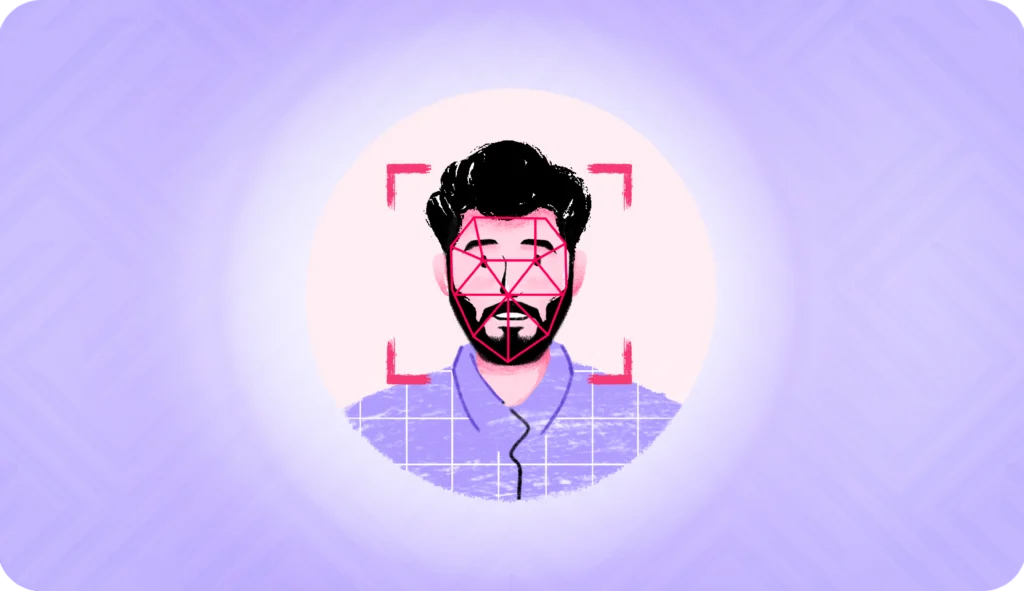
Identification is a “one-to-many” (1:N) process used to determine an unknown person’s identity by searching an entire database. Verification is a “one-to-one” (1:1) process that confirms a person is who they claim to be by comparing a live scan against a specific pre-stored record. Authentication is the ongoing functional application of these technologies, typically used as a gateway to grant or deny access to a secure system or device.
Understanding these nuances is critical for businesses implementing KYC (Know Your Customer) workflows, as it ensures the right level of friction and security is applied to the user journey.
| Term | Meaning | Example |
| Verification | 1:1 match: Confirms a claimed identity by comparing two specific data points. | Matching a live selfie against an Aadhaar card photo during onboarding. |
| Identification | 1:N match: Searches a gallery or database to find a match for an unknown individual. | Running a fingerprint against a criminal database to find a name. |
| Authentication | Access control: The process of proving identity to gain entry to a system. | Using Face ID or a fingerprint to unlock a smartphone or banking app. |
How Does Biometric Verification Work?
Biometric systems gather characteristics that reflect who you are physically or behaviourally. The technology converts these features into mathematical patterns that can be compared securely during verification.
Here’s how they work:
- Enrollment: Users register their biometric data, such as fingerprints, facial features, or iris patterns.
- Storage: The data is encrypted and stored securely, sometimes on platforms like blockchain for enhanced privacy.
- Comparison: During verification, the presented biometric is compared with stored templates to determine a match.
- Verification: A successful match confirms identity and grants access to services or facilities.
In 2026, enterprises combine multiple biometric modalities and behavioural cues to improve performance and prevent spoofing.
| Physiological vs behavioral biometrics In practice, biometric systems revolve around: – Physiological Biometrics: Unique physical traits such as face shape, fingerprints, and iris patterns. – Behavioral Biometrics: Patterns in how you interact with a system, like typing rhythm, voice speech cadence, or how you hold a device. |
Types of Biometric Verification
Biometrics encompasses a variety of technologies that use unique physical or behavioral characteristics for identification and verification. Each type has its specific use, accuracy, and level of security.
Facial Recognition
Facial recognition technology maps facial features to create a digital signature. This biometric system is prevalent in smartphones for unlocking and authorizing payments, in surveillance systems for security purposes, and is increasingly being used by marketers to analyze customer responses to ads. Its effectiveness lies in its non-intrusiveness and ease of integration into existing technologies.
Signature
Signature recognition technology captures the distinctive way a person signs their name, including the pressure applied, the speed of the signature, and the stroke order. It is widely used in banking for authorizing transactions and in legal documents as a consent form. Biometric identification tools use Optical Character Recognition (OCR) technology to read and recognize characters.
Voice Recognition
Voice or speech recognition identifies and verifies individuals based on their voice patterns. It’s used in customer service for authentication in voice-controlled devices like virtual assistants and is an integral part of many multi-factor authentication systems for its ease of use and improved security.
DNA
DNA biometrics utilize the genetic material unique to each individual for identification. This method is unparalleled in accuracy and is pivotal in applications such as forensic investigations, solving crimes, determining familial relationships in paternity tests, and identifying remains in disaster victim identification. DNA analysis requires a biological sample like saliva or blood, and the detailed genetic profile it provides is nearly impossible to falsify.
Fingerprint
Fingerprint scanners are ubiquitous in law enforcement for identifying individuals, in workplaces for time and attendance systems, and in consumer electronics for device security. They offer a quick, reliable identification method by analyzing the ridges and valleys unique to each finger.
Eye or Retina
Eye-based facial biometrics, such as iris and retina scans, are renowned for their precision. They are utilized when high security is critical, like at border crossings or for accessing secure areas in facilities. They identify the unique patterns found in an individual’s iris or the blood vessels in the retina.
Heartbeat
Heartbeat biometrics detect the unique cardiac rhythm of an individual, which can be used in continuous authentication, a growing trend in wearable health technology. This method is particularly promising because it can provide ongoing verification without interrupting user activity.
Biometric Spoofing & Deepfake Attacks (2026 Update)
As biometric systems become more widespread, attackers have evolved beyond simple tricks to highly sophisticated fraud techniques. Modern biometric spoofing and deepfake attacks exploit both physical and digital vulnerabilities in identity verification systems, challenging enterprises to enhance their anti‑fraud defenses.
3D mask attacks
High‑quality silicone or resin masks can replicate a real person’s facial depth and features, fooling low‑quality or legacy biometric sensors into thinking a live person is present.
These 3D masks are often custom‑made with realistic texture and contours, making them effective against systems that lack advanced liveness detection.
Printed photo & replay attacks
Attackers use printed images or screen recordings of a legitimate user’s face to bypass biometric scans.
Replay attacks are particularly dangerous because simple liveness checks (like static image comparisons) can be easily tricked by high‑resolution replayed videos.
Video injection & digital injection attacks
In these attacks, fraudsters bypass the camera entirely by injecting synthetic biometric data directly into the verification pipeline.
This is more dangerous than traditional presentation attacks because it doesn’t require a physical artifact. Instead, the attacker feeds deepfake video or audio into the system as if it came from the user’s device.
AI face swaps & deepfakes

Generative AI tools make it possible to create realistic digital replicas of a user’s face or facial expressions.
These deepfakes can be used in live video challenges or pre‑recorded video submissions, making them incredibly difficult for simple systems to detect.
Voice cloning
AI‑generated voice models can mimic a person’s speech patterns and cadence with high fidelity using just a few seconds of original audio.
Such clones allow attackers to bypass voice biometric checks, especially in call‑center authentication or voice‑activated systems.
Defensive Techniques Against Spoofing
To combat these threats, biometric systems incorporate multiple layers of detection and risk assessment. Here are some of the most common ones:
Passive liveness detection
Passive liveness does not require the user to take any specific action. Instead, the system analyzes natural cues, such as micro‑movements, texture, lighting, and depth signals, to infer if the biometric input came from a live person or a fake representation.
Because it runs silently in the background, passive detection provides a smoother user experience and can detect sophisticated attacks such as deepfakes and high‑quality replay videos.
Active liveness detection
Active methods prompt users to perform specific gestures or responses, for example, blink, smile, turn their head, or read a random phrase.
These challenge‑response actions make it harder for replayed videos or static deepfakes to succeed, but they can add friction to the user experience.
Challenge‑response
Challenge‑response systems combine random prompts with real‑time analysis. The verifier issues a prompt that must be responded to correctly, such as by following an on-screen direction.
This verifies that a live human is interacting rather than a video replay or forged media. These are especially useful in high‑security contexts.
Texture & depth analysis
Sophisticated algorithms analyze texture patterns, light reflections, skin microstructure, and depth cues in biometric captures. These detailed features are hard to simulate convincingly with 2D prints, screens, or even some AI‑generated content.
Many modern presentation attack detection (PAD) systems use convolutional neural networks or photometric techniques to detect subtle inconsistencies.
Risk scoring
Rather than relying on a single check, risk scoring combines multiple signals to assess the likelihood of fraud. This can include device behavior, networking context, velocity checks, historical device use, and anomalies in biometric patterns.
High‑risk interactions trigger additional verification steps, blending passive and active defenses for stronger assurance.
Accuracy Metrics: FAR, FRR & PAD Explained
To gauge system performance, enterprises track key metrics:
- FAR (False Acceptance Rate): How often a system wrongly accepts an imposter.
- FRR (False Rejection Rate): How often a system incorrectly rejects a legitimate user.
- EER (Equal Error Rate): A balance point where FAR equals FRR.
- PAD: The system’s success at blocking fake biometric inputs.
Common Enterprise Use Cases
The integration of the biometric verification system into our daily lives is a testament to its robustness and versatility. Here’s a deeper look into how it’s being utilized across different spheres:
Online banking
Financial institutions are championing biometric verification to safeguard their online platforms. By integrating biometrics authentication for access to banking apps and customer onboarding, banks offer a secure and efficient alternative to traditional authentication methods, fortifying against fraud and ensuring KYC compliance.
Remote identity verification
With a surge in remote transactions, businesses are adopting biometric-based solutions to meet KYC requirements and combat fraud. By analyzing photo IDs against real-time selfies, AI-powered biometric systems ensure that the person presenting the identity document is its legitimate owner.
Airport security
Airports have become high-tech fortresses, thanks to biometrics. By using biometric identifiers and employing facial recognition, airports enhance security and improve passenger experience with expedited check-in and boarding processes, using biometrics as both verification and boarding passes.
Mobile access and authentication
Our smartphones are hubs of personal information, and biometric verification acts as the gatekeeper. Fingerprint and facial recognition technologies are standard security features for unlocking devices and authenticating transactions. This shift towards biometrically-secured mobile access reflects a significant trend in consumer preference for sophisticated and user-friendly security.
Biometric Verification & Indian Regulatory Framework
India’s regulatory environment now mandates robust identity verification controls, including:
- RBI V‑CIP: The Reserve Bank of India now treats Video Customer Identification Process (V‑CIP) the same as in‑person Aadhaar biometric KYC, helping banks onboard customers faster and digitally. This aims to improve accessibility and reduce onboarding time and paperwork.
- SEBI onboarding norms: The Securities and Exchange Board of India (SEBI) allows registered intermediaries to use NPCI’s Aadhaar‑based e‑KYC Setu system for digital client onboarding. This simplifies investor KYC, reduces compliance burden, and speeds up account openings without storing full Aadhaar numbers.
- UIDAI Aadhaar authentication: UIDAI continues to mandate strict consent, encryption, and secure handling for Aadhaar biometric authentication across sectors.
- DPDP Act data obligations: Under the Digital Personal Data Protection (DPDP) Act, organisations processing biometric data must ensure user consent, data minimisation, breach reporting, and secure storage to protect personal information.
Together, these frameworks push enterprises to adopt compliant, secure biometric verification while enhancing user convenience and reducing fraud.
How Enterprises Implement Biometric Verification at Scale
Deploying biometric systems across large user bases requires thoughtful engineering. Let’s see how it happens:
API vs SDK
Businesses integrate biometric systems using APIs for flexible server‑side processing or SDKs for device‑level access to sensors and liveness checks.
Cloud‑based APIs scale easily across millions of users, while SDKs offer tighter device integration and lower latency for mobile apps. Many providers support hybrid models combining both.
Edge vs cloud inference
Edge processing performs biometric matching on the user’s device, reducing latency and data transfer risks, especially in low‑connectivity areas.
Cloud inference centralizes heavy AI analysis and liveness detection, letting enterprises scale without managing hardware or models locally.
Latency considerations
Enterprises need biometric systems that respond quickly. Edge inference can return results in milliseconds, and cloud processing ensures accurate verification for complex cases.
Mobile optimization (3G/Low Bandwidth)
Optimized SDKs compress images, use small payloads, and implement retry logic so biometric workflows function even under poor connectivity.
Data localization (India DPDP Act)
Under India’s DPDPA, biometric data must be processed with consent and stored in accordance with its purpose and retention policies, with strict controls on cross‑border transfers.
Audit logging
Enterprises record timestamped biometric events, decisions, and API calls in secure logs to support compliance, traceability, and anomaly detection.
How Biometric Verification Reduces Fraud
The incursion of biometrics into security protocols significantly enhances fraud prevention measures across multiple sectors. Here’s how it makes a difference:
- Eliminating password vulnerabilities: Biometrics replace the traditional password, addressing the security gaps posed by easily compromised, forgotten, or reused credentials. Unlike passwords, biometric characteristics are unique to the individual and cannot be easily shared or stolen, providing a more robust defense against credential-based breaches.
- Enhancing multi-factor authentication (MFA): By incorporating biometrics into MFA, the security of authentication processes is significantly strengthened. Biometrics, as a second factor in MFA, can block a vast majority of automated attacks, offering a user-friendly experience without compromising security.
- Improving re-verification processes: Biometrics streamline re-verification processes by reducing reliance on easily exploitable methods like password reset links or knowledge-based authentication. Biometrics remain constant and can’t be forgotten, making them a reliable factor for authentication, even when devices are lost or replaced.
- Securing digital onboarding: In digital onboarding, biometrics such as facial recognition can verify that new account holders are who they claim to be, helping prevent identity theft and fraud. This is particularly crucial in banking and other regulated industries.
- Liveness detection: To ensure that the person attempting to access the system is actually present and not a fraudulent representation, biometric liveness detection is used. This can differentiate between real users and masks, photos, or other spoofing attempts.
Future of Biometric Identity (2026–2030 Outlook): From Static Verification to Continuous Trust
As fraud evolves and AI‑powered threats grow, static, point‑in‑time identity checks are becoming insufficient. Enterprises are shifting toward continuous authentication that continuously monitors identity signals such as behavior, device patterns, and risk context throughout a session. According to industry reports, behavioral biometrics adoption has risen more than 35% as part of continuous verification strategies.
Modern systems also embrace risk‑based dynamic identity models that adjust the level of scrutiny based on user behavior, device reputation, and contextual risk scores. These platforms analyze multiple signals, including behavioral biometrics and transaction patterns, to dynamically escalate verification only when needed, reducing friction for legitimate users. In fact, the market for risk‑based authentication is forecast to grow from $5.58 billion in 2025 to $7.72 billion by 2030, reflecting this shift.
In parallel, zero-trust onboarding is gaining traction, where no identity is trusted by default, and every access request is evaluated in context, enforcing least‑privilege access and continuous verification throughout the access lifecycle. Many organizations now prioritize identity as the core security perimeter.
Finally, the industry is moving toward AI‑native identity infrastructure that integrates machine learning, risk analytics, and adaptive decisions into identity and access systems. AI enables smarter threat detection, scalable continuous authentication, and real‑time identity assurance, making identity the foundation of cybersecurity from onboarding to ongoing access management.
How HyperVerge Enables Secure Biometric Verification
If concerns about identity verification are on your radar, you’re not alone. Identity fraud can have far-reaching consequences, not just financially but also for your brand’s reputation.
HyperVerge delivers data-driven identity verification solutions that combine AI-powered analytics with extensive real-world datasets to ensure reliable identity checks. Our platform is vertical-specific, serving banks, NBFCs, and fintech companies with tailored workflows that meet industry compliance standards.
We prioritize performance, optimizing uptime, latency, and verification accuracy to provide seamless customer experiences. Advanced risk-based defenses protect against deepfakes, spoofing, and synthetic identities, keeping enterprises one step ahead of evolving fraud threats.
Book a demo today to stay one step ahead of potential threats.