






For years, digital onboarding followed a simple playbook. Capture a live selfie, match it to an official ID, run a liveness check (blink, smile, turn your head), and you had reasonable proof that a real person was on the other end of the camera.
That playbook assumed one thing: that the video reaching your server actually came from a camera.
Modern fraud no longer honors that assumption. If your deepfake defenses live entirely in server-side APIs, the problem is where your security runs, and no amount of model accuracy fixes it. Here is why India’s onboarding front line is shifting from after-the-fact detection to origin-level capture security, and what that shift looks like in practice.
The Onboarding Crisis by the Numbers
The threat of synthetic identity fraud in India is no longer an academic debate; it is a full-scale commercial crisis.
- The macro toll: Cyber fraud drained ₹22,495 crore (about US$2.7B) from the Indian economy in 2025. 47% of Indian adults report being hit by, or knowing a victim of, an AI voice or deepfake scam.
- Concentrated targets: Fraud networks go where the money moves. Digital lending absorbs roughly 50% of all deepfake attacks, with broking and stock trading next at around 20%.
- Attack density: In February 2026, a major Indian brokerage found that 1 in 72 account-opening attempts was a synthetic identity. Another leading fintech platform logged 2,152 pipeline injection attacks in a single three-day window.
- The regulatory alert: In June 2026, a major NBFC lost ₹15 to 20 crore to a fraud built on deepfake video-KYC sessions and forged digital statements. The Ministry of Home Affairs (via I4C) responded with a national advisory: deepfakes are actively bypassing standard facial authentication, liveness checks, and V-CIP protocols.
Why Server-Side “Detection” Keeps Losing
Many risk teams believe the solution is simple: just buy a better deepfake detector.
Unfortunately, this approach is fundamentally flawed. Content-only detection is a reactive arms race, and the other side has more players. Synthesis researchers outnumber defense researchers roughly 100 to 1. Even state-of-the-art detectors lose up to 50% of their accuracy when they leave pristine lab conditions and meet messy, in-the-wild deepfakes.
Fraudsters in India are already outsmarting server-side detectors using model-permutation attacks:
- The Generation: A fraudster generates a photorealistic selfie using an on-device model like Gemini.
- The Scramble: Instead of uploading it directly, they pass the image into a second model (such as Meta-AI) with a simple prompt like “change hair color while keeping everything else the same”.
- The Bypass: This minor modification scrambles the unique “generation signatures” that server-side algorithms search for. Security teams are now catching attacks that bear watermarks from both AI models simultaneously.
Furthermore, fallback measures like invisible provenance watermarks are easily stripped or scrambled by spectral-removal techniques, which boast 79% to 91% removal rates. Trusting attackers to label their own fakes is not a viable security strategy.
The Real Problem: Presentation vs. Injection Attacks
Standard KYC platforms are built to stop presentation attacks: a printout, a phone screen, a silicone mask held up to the camera. Presentation Attack Detection (PAD) handles these well, and it should stay in your stack.
Organized fraud syndicates have simply stopped knocking on that door. They use injection attacks instead.
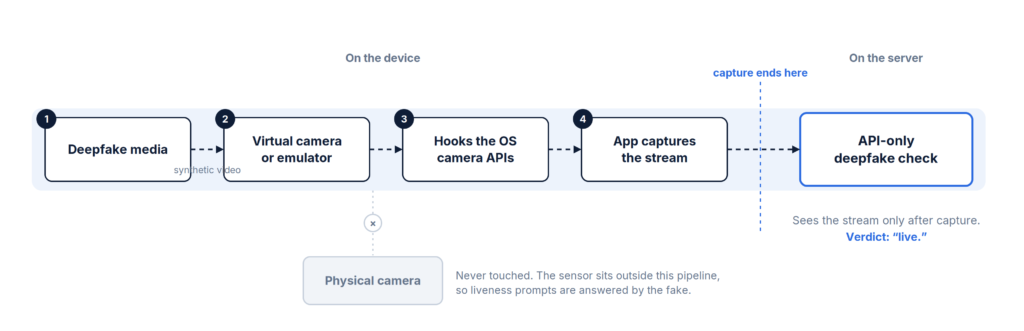
By utilizing free virtual camera tools or emulators, fraudsters bypass the physical camera hardware entirely. They hook directly into the operating system’s camera framework (like Android’s Camera2 or iOS’s AVFoundation) and stream high-fidelity synthetic video straight into your app.
An API-only check runs on the server, which means it only ever sees media after submission. It has no way of knowing the camera sensor was never involved. So it runs its very sophisticated facial math on a perfectly injected synthetic stream and stamps it “live.”
The model did its job. It was just standing guard at the wrong location.
Securing the Source: The SDK Imperative
Stopping injection attacks means running security on the device, at the millisecond of capture.
An on-device SDK acts as the anchor. Rather than analyzing pixels after the fact, it verifies device integrity, probes for emulators and virtual camera drivers, and cryptographically signs video frames at the hardware level.
If the stream does not originate from a genuine, unmanipulated camera sensor, the session is blocked before a single frame reaches your server.
| This is not vendor theory. Independent evaluation by the World Economic Forum found that off-the-shelf camera-injection tools fail consistently only against onboarding systems that combine dynamic prompts with SDK-level integrity checks. |
The Looming Regulatory Mandate
The migration to SDK-based capture isn’t just a technical recommendation; it is rapidly becoming a compliance necessity in India:
- RBI V-CIP framework (KYC Master Direction, Paragraph 18): The guidelines mandate robust liveness and spoofing detection, and require regulated entities to regularly upgrade technology against emerging fraud vectors. Pipeline injection invalidates the framework’s core historical assumption that a live video stream proves physical presence. Upgrading to SDK-level Injection Attack Detection (IAD) is the natural compliance step to keep V-CIP hygiene intact.
- MeitY IT Amendment Rules 2026 (in force February 20, 2026): The updated gazette legally defines synthetic media and mandates provenance metadata and labeling. An SDK at capture gives financial institutions a cryptographically signed chain of custody from the point of origin, meeting both the letter and the spirit of the rules.
Building a Defense-in-Depth Priority Stack
No single layer solves this. The architecture that holds is tiered, with each layer defending a different point in the pipeline:
1. Primary: On-device SDK (Injection Attack Detection)
Defends the camera pipeline. Locks down device state, blocks virtual camera hooks, and signs the feed cryptographically at capture.
2. Secondary: Liveness (Presentation Attack Detection)
Defends the camera sensor. Catches physical screens, printed photos, and silicone replicas through randomized active and passive liveness challenges.
3. Tertiary: Deepfake forensic detection
Defends the image file. Analyzes compression and pixel artifacts on the server for legacy or unverified streams where capture provenance cannot be established.
An API-only stack skips the first layer entirely, which means the most common modern attack path goes unexamined by design.
The fix is a shift in location, not a bigger model. Secure the source, sign the capture, and let the server verify what the device has already proven.
If you want to see where injection attacks would enter your current flow, talk to us and run your onboarding journey past our team.