






What is voter ID validation?
Voter ID validation confirms that an Elector’s Photo Identity Card (EPIC) is genuine and belongs to the person presenting it, by reading the card and checking the EPIC number against the Election Commission of India’s electoral roll. The check returns the registered name, age, gender, constituency and polling details, which lets a bank or lender verify identity and address from a document most Indian adults already hold.
Voter ID is one of the six officially valid documents (OVDs) a Regulated Entity may accept for customer identification under RBI’s 2025 KYC Directions, alongside the passport, driving licence, proof of possession of Aadhaar, NREGA job card and the National Population Register letter. That is why lenders, insurers and fintechs verify it at onboarding rather than simply photographing it.
If you want to check your own voter ID, use the Election Commission’s Voters’ Service Portal and search the electoral roll by EPIC number, name or mobile number. The rest of this page is for businesses verifying a customer’s voter ID as part of KYC.
The process of extracting the details from the voter ID card and verifying the same against centralized government databases is called the voter ID validation process. This process can help in identity verification for name, address, and age verification.
Why is Voter ID Validation Important?
Voter ID is the most widely held OVD after Aadhaar, and the one customers most often offer when they do not want to share their Aadhaar number. Validating it, rather than storing an image, matters for three reasons.
- Compliance: the KYC Directions require an RE to verify the OVD, not merely collect it. An unverified voter ID image is a documentation gap at audit.
- Fraud control: EPIC numbers, photographs and addresses on voter ID cards are edited more easily than on Aadhaar or passports, and templates vary by state and issue year. A database check catches a forged or borrowed card that visual review passes.
- Conversion: OCR plus a registry check fills the KYC form from the card and clears the customer in seconds, which keeps drop-off low in digital journeys.
How Does Voter ID Validation API Work?
Voter ID validation API has two components: Voter ID OCR and Voter ID verification
Voter ID OCR
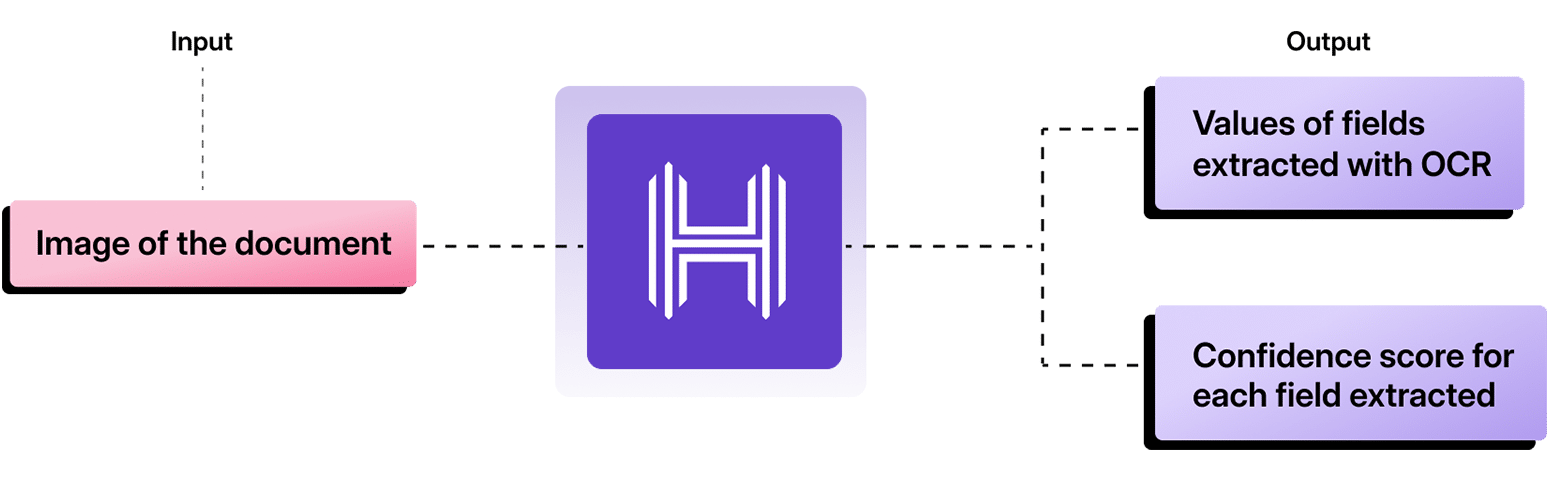
Voter ID OCR API identifies and extracts text information from images or scans of voter IDs. This is done by employing advanced OCR algorithms. Here is how it works:
- Capture an image of the voter ID
- Pre-process to enhance the clarity of the image
- Identify text regions and segment characters
- Recognizing characters using visual features or machine learning
- Extract the recognized text into a digital format
The extracted information usually includes the voter ID holder’s name, EPIC number, date of birth, and other relevant details.
Voter ID Verification
Voter ID card verification API is used to verify voter ID. The extracted EPIC number from the ID is given as input. Then the entire details of the customer are given as an output. This helps to verify the customer’s identity.
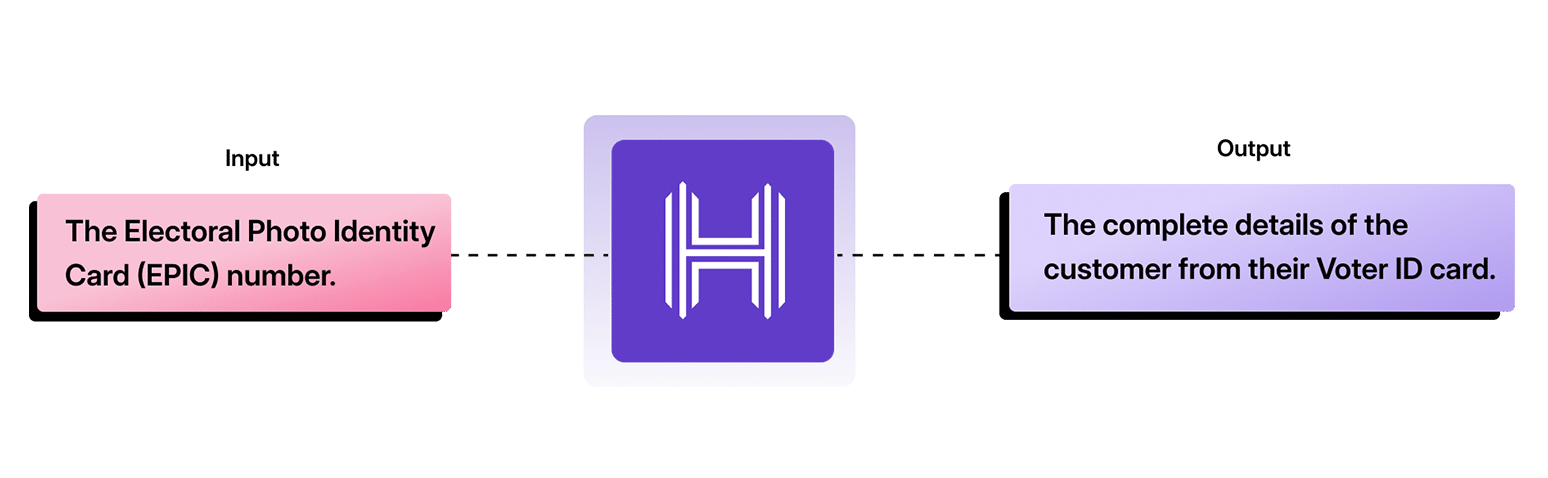
Thus voter ID OCR API and voter verification API work together as voter ID validation API to verify the details of the voter ID. Here’s an overall view of how the voter ID validation API works:
1. Integration: Integrate the Voter ID OCR and Voter ID Validation API into your system or application using unique API keys provided by the service provider.
2. Data Input and Request: Provide the scanned image of the Voter ID card to the Voter ID OCR API. The Voter ID Verification API receives the extracted details as input.
3. OCR Processing: The Voter ID OCR utilizes advanced Optical Character Recognition (OCR) technology to accurately extract text from the scanned image of the Voter ID cards.
4. Validation Query: The Voter ID Verification API queries authorized databases, such as voter registration databases maintained by election authorities. This helps in validating the extracted details against the voter ID records.
5. Validation Result: Based on the information obtained from the query, the Voter ID Verification API generates a validation result indicating the authenticity and validity of the voter ID details.
6. Response: The API sends back the validation result to the requesting system or application. This response can be in various formats such as JSON, XML, or plain text, depending on the API specifications.
A full pass, OCR plus registry check, typically completes in a few seconds. When the EPIC number is not found, the usual causes are a recently issued card not yet reflected in the roll, a card issued before the current EPIC format, or a misread digit; the API returns a distinct status for each so the journey can retry OCR or fall back to another OVD.
Challenges with Existing Solutions
Most voter ID failures in onboarding come from the document itself rather than the customer.
- Template variety: EPIC cards have been issued in several layouts since 1993, in regional languages and in both laminated and PVC forms, and generic OCR misreads older formats.
- Image quality: low-light captures, glare on laminated cards and cropped edges push records to manual review.
- Manual keying: when OCR fails, agents type the EPIC number by hand, and a single wrong character returns a false “not found”.
- Slow registry responses: journeys with no fallback stall when the roll lookup is slow or unavailable.
- Friction: asking customers to enter EPIC number, name and date of birth by hand is the single largest cause of drop-off on this document.
HyperVerge’s Voter ID Verification API
- Registry check against the Election Commission’s electoral roll, returning name, age, gender, constituency and part details for matching.
- OCR trained on every EPIC layout in circulation, including regional-language cards, with 99.5% field-level accuracy on clear captures.
- Real-time image checks for blur, glare, cut corners, black-and-white copies and screen recapture before the record is accepted.
- Auto-fill of the KYC form from the card, so the customer confirms rather than types.
- Configurable fallbacks: retry OCR, switch to manual EPIC entry, or route to another OVD without restarting the journey.
- Audit-ready output: every check is logged with timestamp and result for the KYC record.
The Voter ID OCR API and Voter ID Verification API can be used separately or chained inside an identity verification journey. For the full list of accepted documents and what each verifies, see the officially valid documents guide.
Build End-to-end Journeys with HyperVerge ONE
Does your onboarding procedure for financial products use several-point solutions? You can build seamless end-to-end journeys with HyperVerge ONE. Without ever writing a line of code, you can create intuitive UI/UX experiences and easily set up user onboarding procedures using our integration capabilities.
Worried about user drop-offs during downtimes? With the help of HyperVerge, you can configure automated fallback alternatives, giving your users a seamless experience irrespective of the circumstance. To improve user experience and increase success rates, you may also go further into conversion rate analytics and find and optimize friction points.
Explore HyperVerge ONE here. Want to see it in action? You can request a customized demo here.
